
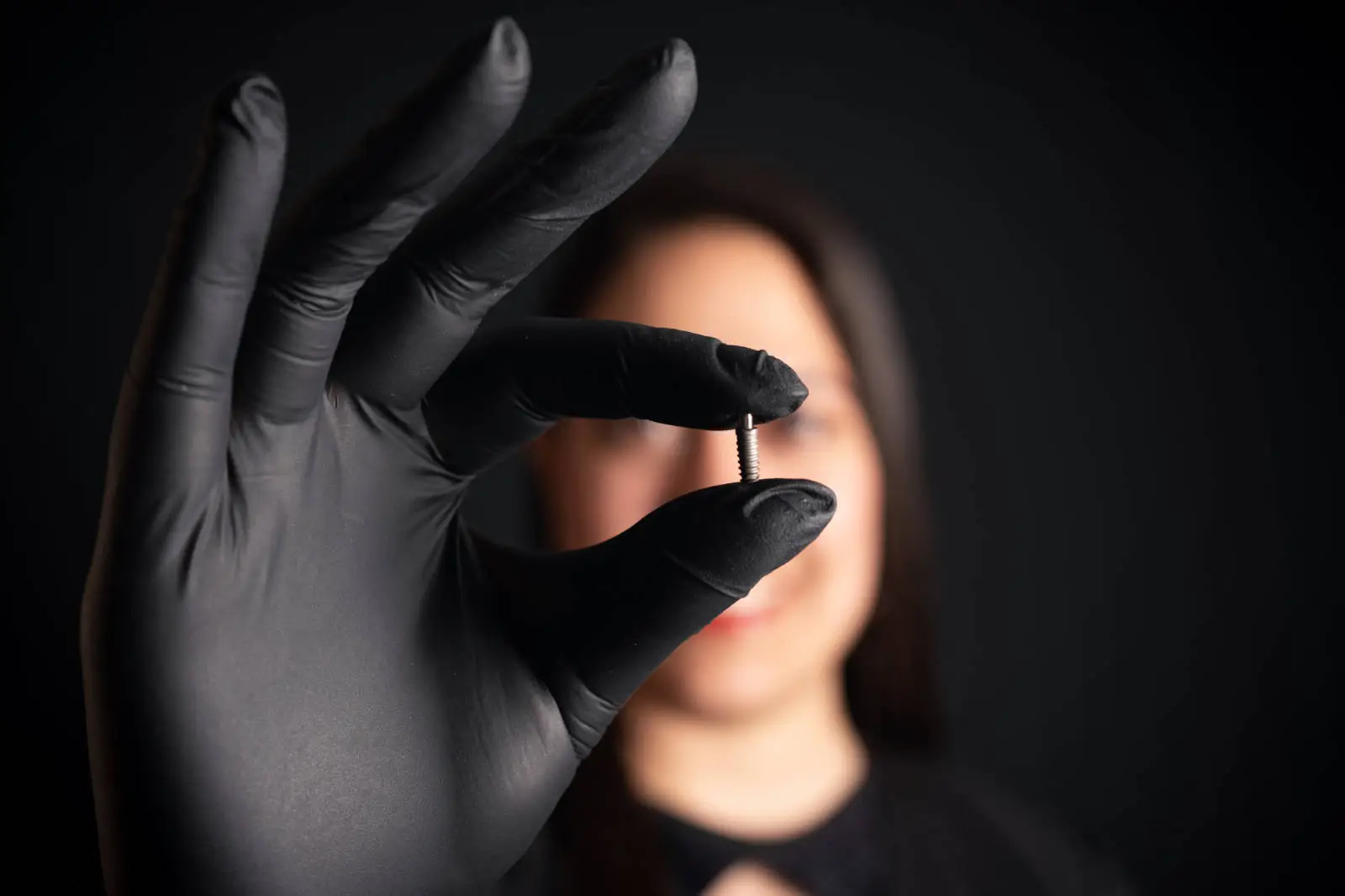

What are dental implants?
Dental implants are titanium or zirconium structures that are surgically placed within the maxillary or mandibular bone to replace the root of a lost tooth. Once integrated into the bone, they serve as a base for placing a crown, a bridge, or even a complete prosthesis.
Their main advantage is that they allow for the replacement of lost teeth in a way that is very similar to a natural tooth, both in function and appearance.
💡 In short: a dental implant replaces the root of the tooth and provides a firm base for placing a new dental piece.
When are dental implants recommended?
Dental implants can be an excellent option when there is a loss of one or several teeth.
They are generally recommended for patients who present:
- Loss of a single tooth.
- Absence of several consecutive teeth.
- Total loss of teeth in one arch.
- Difficulty using removable prostheses.
- Good overall health and sufficient bone quantity.
Before performing the treatment, the implantologist will evaluate each case through X-rays or tomography to determine if the patient is a candidate.
Parts of a dental implant
Although visually it appears to be a single tooth, an implant is made up of three main components.
1️⃣ Implant
It is the titanium or zirconium screw that is placed within the bone and replaces the root of the tooth.
2️⃣ Abutment
It is the piece that connects the implant with the dental crown.
3️⃣ Crown
It is the visible part that mimics the shape, size, and color of a natural tooth.
These three parts work together to restore the function and aesthetics of the smile.
How are dental implants placed?
The procedure is performed in stages to ensure proper integration with the bone.
1. Evaluation and planning
The specialist conducts a clinical examination, X-rays, and, in many cases, a tomography to assess the quantity and quality of the available bone.
2. Implant placement
Under local anesthesia, the implant is inserted into the bone through a controlled surgical procedure.
The surgery usually lasts between 45 minutes and 2 hours, depending on the number of implants.
3. Osseointegration
During the following months, the bone naturally bonds to the implant in a process known as osseointegration.
This period usually lasts between 3 and 6 months.
4. Placement of the abutment and crown
Once the implant has properly integrated, the abutment is placed and subsequently the final crown, designed to resemble the rest of the teeth.
Benefits of dental implants
Dental implants offer numerous advantages over other treatments.
✅ Natural appearance
The crown reproduces the color, shape, and size of the original tooth.
✅ Restores chewing function
They allow you to comfortably eat virtually any food.
✅ Preserves bone
By replacing the root of the tooth, they help reduce bone loss that occurs after an extraction.
✅ Does not damage neighboring teeth
Unlike some bridges, it is not necessary to grind down healthy teeth to place them.
✅ Great durability
With good care, an implant can last for many years and even a lifetime.
✅ Greater comfort
It does not move when speaking or eating, providing a sensation very similar to that of a natural tooth.
Types of dental implants
Depending on the case, the dentist may recommend different options.
| Type | When is it used? |
|---|---|
| Single implant | To replace a single tooth. |
| Bridge on implants | To replace several consecutive teeth. |
| Complete prosthesis on implants | To replace an entire dental arch. |
| All-on-4 or All-on-6 | Patients who have lost all teeth and want a fixed prosthesis. |
The choice will depend on the number of lost teeth and the conditions of the bone.
How much do dental implants cost in Peru?
The price can vary depending on the type of implant, the experience of the specialist, and whether additional procedures are required.
| Treatment | Reference price |
|---|---|
| Single dental implant | S/ 2,000 to S/ 5,000 |
| Implant with crown | S/ 3,500 to S/ 6,500 |
| Fixed prosthesis on implants | From S/ 20,000 |
Important: These prices are approximate and may vary depending on the diagnosis and the clinic.
📌 What influences the price?
The final cost will depend on several factors.
Among them:
- Material of the implant (titanium or zirconium).
- Number of implants needed.
- Type of crown.
- Quality of the dental laboratory.
- Technology used.
- Need for bone grafts or maxillary sinus lift.
- Experience of the implantologist.
A clinical evaluation will allow for the establishment of a personalized budget.
Dental implants vs removable prostheses
Both alternatives allow for the replacement of lost teeth, although they present important differences.
| Feature | Dental implants | Removable prostheses |
|---|---|---|
| Stability | ⭐⭐⭐⭐⭐ | ⭐⭐⭐ |
| Aesthetics | ⭐⭐⭐⭐⭐ | ⭐⭐⭐⭐ |
| Bone preservation | Yes | No |
| Duration | Very high | Lower |
| Removed for sleeping | No | Yes |
Although the initial investment is usually higher, implants offer a more stable and durable solution.
Care after placing dental implants
The success of the treatment largely depends on the post-operative care.
It is recommended to:
- Brush after every meal.
- Use dental floss or interdental brushes.
- Avoid smoking.
- Follow the medication prescribed by the specialist.
- Attend regular check-ups.
- Get professional cleanings when necessary.
Good hygiene helps prevent infections around the implant and prolongs its lifespan.
❓ Frequently asked questions
The placement of the implant is performed under local anesthesia, so the procedure is usually not painful. After the surgery, there may be slight discomfort or swelling that is generally controlled with the medications prescribed by the specialist.
With proper oral hygiene and regular check-ups, implants can remain in good condition for many years. In numerous cases, they remain functional for decades.
Depending on the case, the implantologist may recommend procedures such as a bone graft or a maxillary sinus lift to create an adequate base before placing the implant.
Yes. The crowns are custom-designed to integrate with the color, shape, and size of the natural teeth, achieving a very aesthetic result.


