
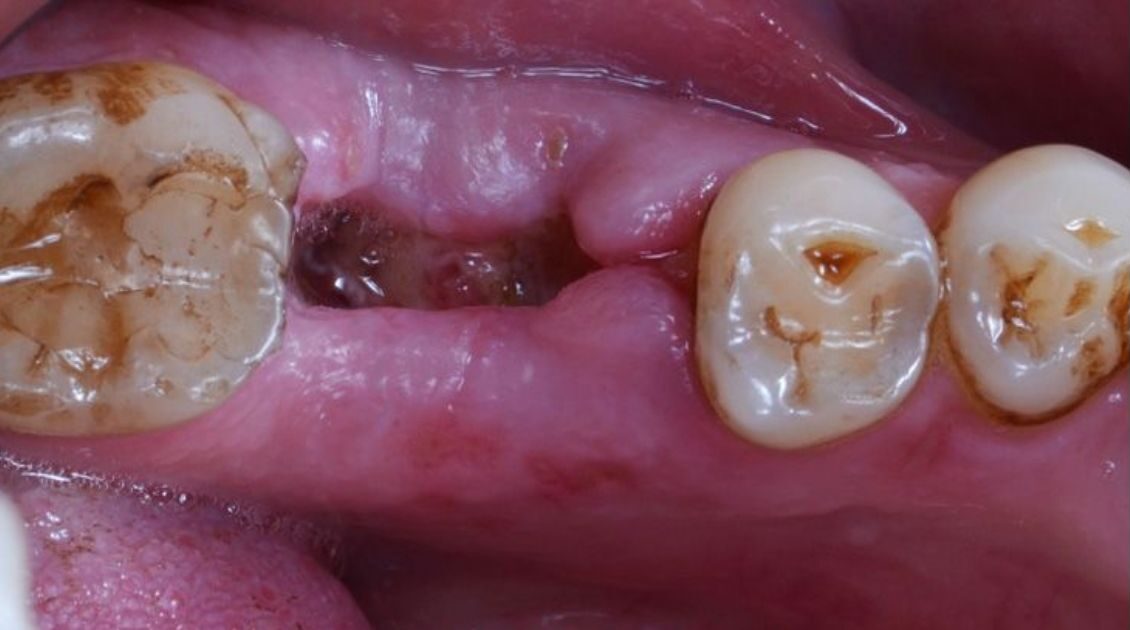

💡 In summary: if everything evolves normally, the pain and inflammation decrease during the first week, the gum usually closes around two weeks, and the bone gradually regenerates in the following months.
How long does it take to heal after a wisdom tooth extraction?
Recovery occurs in stages. Each stage has normal changes that help the wound heal properly.
| Stage | Approximate time | What happens? |
|---|---|---|
| 🩸 Blood clot formation | First 24 hours | Bleeding stops and healing begins. |
| 😷 Maximum inflammation | Days 2 to 3 | It is normal for swelling and discomfort to increase. |
| 🌱 Gum repair | Days 4 to 7 | Pain decreases and the first new tissues appear. |
| 😊 Gum closure | Week 2 | The superficial wound is usually almost closed. |
| 🦴 Bone healing | Weeks 3 to 16 | The bone continues to regenerate internally. |
Recovery timeline
🔹 First 24 hours
🩸 Blood clot formation
During this period, the body creates a blood clot, which protects the bone and gum while initiating the healing process.
It is normal for the following to occur:
✅ Mild bleeding.
✅ Moderate pain.
✅ Initial swelling.
Recommendations
🧊 Apply cold compresses.
😴 Rest with your head elevated.
🥣 Consume cold and soft foods.
🚭 Do not smoke.
🥤 Do not use straws.
🔹 Days 2 to 3
😷 Maximum inflammation
This is the stage where inflammation usually peaks, especially if the tooth was impacted or if more complex surgery was required.
It is normal to experience
✅ Swollen face.
✅ Discomfort when opening the mouth.
✅ Mild or moderate pain.
✅ Slight bruising in some patients.
Continue doing
✔ Apply cold during the first 24 hours and follow your dentist’s instructions.
✔ Avoid intense exercises.
✔ Maintain good oral hygiene without brushing directly on the wound.

🔹 Days 4 to 7
🌱 Recovery begins to be noticeable
Inflammation starts to decrease and the body forms new tissues over the area where the tooth was.
During these days, most patients feel a significant improvement.
It is normal to see
✅ Less inflammation.
✅ Less pain.
✅ Greater comfort when speaking and eating.
You can start to
🍝 Eat more substantial foods, as long as they are not too hard or hot.
🚶 Resume light activities if the dentist allows it.
🔹 Week 2
😊 Gum closure
In most patients, the gum is already practically closed.
If non-resorbable stitches were placed, the dentist may remove them during this stage.
Generally, the following occurs
✅ Inflammation disappears.
✅ Pain practically disappears.
✅ The superficial wound is already closed.
🔹 Weeks 3 to 4
🦴 Bone healing
Although the gum appears healthy, the bone continues to regenerate internally.
This process is slower and can extend over several months.
At this stage
✅ You can return to your usual diet.
✅ Sensitivity decreases progressively.
✅ The bone begins to regain its structure.

What accelerates and what delays recovery?
| ✅ Accelerate recovery | ❌ Delay recovery |
|---|---|
| Follow the dentist’s instructions | Smoking or vaping |
| Apply ice during the first 24 hours | Consuming alcohol during the first days |
| Sleep with your head elevated | Not taking the prescribed medications |
| Maintain good oral hygiene | Not brushing properly |
| Consume soft foods | Eating very hard or hot foods |
| Attend follow-up appointments | Previous infections or uncontrolled diseases like diabetes |
What can I eat after the extraction?
🥣 Day 1
- Yogurt.
- Gelatin.
- Ice cream.
- Puree.
- Applesauce.
- Water.
🍝 Days 2 to 3
- Warm soups.
- Mashed potatoes.
- Oatmeal.
- Scrambled eggs.
- Soft fish.
After the first week
You will be able to gradually return to a normal diet, avoiding extremely hard foods until your dentist indicates otherwise.
When should I be concerned?
Consult your dentist immediately if you experience:
❌ Heavy bleeding that does not decrease.
❌ Intense pain that worsens after the third day.
❌ Fever.
❌ Pus.
❌ Persistent bad odor.
❌ Constant bad taste.
❌ Swelling that continues to increase after the fourth day.
These symptoms may indicate a complication, such as an infection or dry socket.
📋 Normal symptoms vs alarming symptoms
| ✅ It is normal | 🚨 It is not normal |
|---|---|
| Moderate inflammation | Very intense pain that increases |
| Mild bleeding during the first hours | Heavy bleeding after 24 hours |
| Pain manageable with medication | High fever |
| Sensitivity when opening the mouth | Pus discharge |
| Slight difficulty chewing | Intense and persistent bad odor |
❓ Frequently asked questions
Most people can return to a nearly normal diet between 7 and 14 days, depending on how healing progresses and the complexity of the extraction.
Yes. The space is completely normal and will gradually be filled with new tissue and later with bone.
It is recommended to wait at least 48 to 72 hours for light activities and approximately a week for intense exercises, unless the dentist indicates a different time.
Yes. In many cases, it corresponds to healing tissue or fibrin, a substance that helps repair the wound. It should not be confused with pus.
Ideally, both should be avoided for at least 72 hours, although many specialists recommend waiting a week to reduce the risk of dry socket and delayed healing.


