
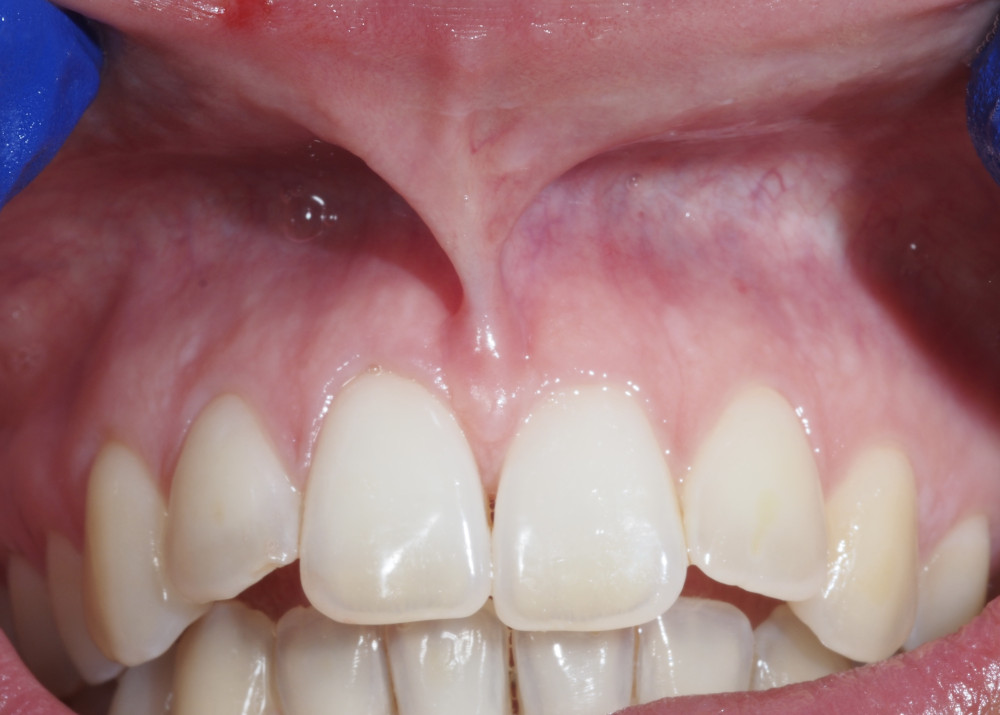

What is the labial frenulum?
The labial frenulum is a small band of tissue that connects the upper or lower lip to the gum. There are two main types:
- Upper labial frenulum: located between the upper lip and the central gum, just above the incisors.
- Lower labial frenulum: connects the lower lip to the lower gum.
It is normal for all people to have frenula, but in some cases, their size, thickness, or position can cause problems that affect everything from dental aesthetics to phonation or feeding in infants.
The labial frenulum is a crucial structure for lip mobility and sound formation during speech.
What is the function of the labial frenulum?
The frenulum serves mechanical functions such as:
- Stabilizing lip movement.
- Allowing proper lip mobility during chewing and speaking.
- Assisting in sound formation during language development.
However, when the frenulum is too thick, short, or improperly located, it can interfere with these functions and become a problem.
When is the labial frenulum a problem?
A frenulum is considered abnormal or pathological when:
- It limits lip movement.
- It causes separation between the front teeth (diastema).
- It generates pain or tightness when moving the lips.
- It interferes with sucking or breastfeeding in infants.
- It affects the pronunciation of certain sounds.
- It contributes to gingival recession (receding gums).
- It generates tension in orthodontics or prevents the closure of dental spaces.
It is important to mention that not all frenula that cause diastema need to be surgically corrected. In many children, the space between the teeth closes naturally with growth or during orthodontic treatment.
What is a frenectomy or labial frenulum surgery?
A frenectomy is a minor surgery that involves cutting or partially removing the frenulum to allow for proper lip movement. It can be performed using:
- Surgical scissors (traditional method).
- Electrosurgery.
- Dental laser (less pain and better healing).
It is a quick, outpatient procedure with a simple recovery. It can be performed on children, adolescents, or adults, depending on the diagnosis of the dentist or maxillofacial surgeon.
The frenectomy is a safe and effective procedure to resolve issues related to the labial frenulum.
💡 When is it advisable to operate on the frenulum?
Surgery is recommended in cases such as:
- Persistent interincisal diastema in children over 8 years old, when the permanent incisors have erupted.
- Pronunciation problems (difficulty with phonemes such as “f”, “v”, or “p”).
- Tension that interferes with prosthetics or orthodontic appliances.
- Gum irritation or recession.
- Suction problems in newborns.
Before making a decision, each case should be evaluated by a specialist in pediatric dentistry, orthodontics, or oral surgery.
| Type of Case | Recommendation | Treatment Method |
|---|---|---|
| Persistent diastema in children over 8 years old | Surgery recommended | Frenectomy with surgical scissors or laser |
| Pronunciation problems | Surgery recommended | Frenectomy with laser for better healing |
| Tension that interferes with prosthetics or orthodontic appliances | Surgery recommended | Frenectomy with electrosurgery |
| Gum irritation or recession | Surgery recommended | Frenectomy with laser |
| Suction problems in newborns | Surgery recommended | Frenectomy with laser for minimal invasion |
💡 How much does labial frenulum surgery cost in Peru?
Prices may vary depending on the type of procedure, location, and treating professional. Below, we provide an updated reference range for Lima and other cities in the country:
| Type of procedure | Approximate price (Soles) |
|---|---|
| Initial dental evaluation | S/ 60 – S/ 120 |
| Traditional frenectomy | S/ 250 – S/ 500 |
| Laser frenectomy | S/ 500 – S/ 900 |
| Frenectomy in university clinics | S/ 100 – S/ 300 |
In some cases, if the patient is undergoing orthodontic treatment, the cost may be included in the plan.

💡 Recommendations before and after a frenectomy
Before the surgery:
- Attend a specialized evaluation.
- Ask about anesthesia options and the method to be used.
- If the patient is a child, prepare them emotionally with simple language.
After the surgery:
- Avoid very hot or acidic foods for 2-3 days.
- Maintain good oral hygiene without brushing directly on the area.
- Administer pain relievers or anti-inflammatories if the dentist indicates.
- Perform lip mobility exercises (when indicated by the specialist).
💡 Does the operation leave a scar? Are there risks?
The frenectomy generally does not leave visible scars and has a quick recovery. With laser, healing is even cleaner and less uncomfortable. As with any intervention, there may be minimal risks such as:
- Minor bleeding.
- Temporary pain.
- Infection (very uncommon if hygiene is maintained).
The labial frenulum surgery is a safe and accessible procedure in Peru, especially if performed in a timely manner and by a qualified professional.
💡 Frequently Asked Questions
In Lima, labial frenulum treatment is performed in clinics with experience in oral and maxillofacial surgery. The office of Dr. Andrea Contreras offers evaluation and personalized treatment for children, youth, and adults.
The best specialists in labial frenulum in Peru are those with training in oral and maxillofacial surgery and a comprehensive approach. In the office of Dr. Andrea Contreras, the procedure is performed with precise clinical criteria and modern technology.
Yes, it is possible to schedule an online consultation for labial frenulum evaluation. In the office of Dr. Andrea Contreras, you can arrange a prior appointment to receive guidance and define the appropriate treatment before in-person care.
The best maxillofacial surgeons in Lima are those who combine clinical experience and personalized care. The office of Dr. Andrea Contreras stands out for offering such treatments with professional follow-up and a safe approach for each patient.


