
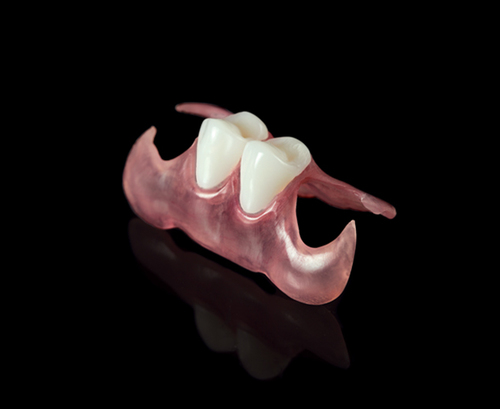

What is a removable partial denture?
A removable partial denture is a dental device designed to replace one or more missing teeth when there are still healthy natural teeth that can serve as support.
Unlike a fixed prosthesis, this device can be easily removed for cleaning and reinserted without the need for surgical procedures.
Its main function is:
✅ Recover the ability to chew.
✅ Improve pronunciation when speaking.
✅ Prevent neighboring teeth from shifting.
✅ Maintain the bite balance.
✅ Improve the appearance of the smile.
💡 In short: only replace the missing teeth, preserving those that are still healthy.
Who needs a removable partial denture?
It is generally recommended when the patient:
- He has lost one or more teeth.
- Maintains strong natural teeth.
- Does not wish to or cannot have implants.
- Look for a more economical alternative.
- Needs a temporary solution before another treatment.
Not all patients require the same type of prosthesis, so a clinical evaluation is always necessary.
Removable partial prosthesis vs complete prosthesis
Many people confuse both treatments.
| Feature | Removable partial denture | Complete denture |
|---|---|---|
| Replaces some teeth | ✅ Yes | ❌ No |
| Replaces all teeth | ❌ No | ✅ Yes |
| Needs natural teeth | ✅ Yes | ❌ No |
| Can be removed | ✅ Yes | ✅ Yes |
Types of removable partial dentures
There are currently three main types.
Each one responds to different clinical needs and budgets.
1️⃣ Metal removable partial prosthesis (skeletal)
It is considered the most resistant and durable option.
It is made up of a metal structure that supports artificial resin teeth.
When is it recommended?
- Loss of several teeth.
- Patients seeking a long-term solution.
- People with good periodontal health.
Advantages
✔ Very durable.
✔ Lower volume inside the mouth.
✔ Excellent stability.
✔ Longer lifespan.
Disadvantages
- The hooks can be visible.
- Price higher than that of acrylic prostheses.
2️⃣ Acrylic removable partial denture
It is made entirely of acrylic resin.
It is generally used as a provisional treatment or when the patient is looking for a more economical alternative.
Advantages
✔ Lower cost.
✔ Easy repair.
✔ Fast manufacturing.
Disadvantages
- Thicker.
- Less resistance.
- It can break more easily.
3️⃣ Flexible removable partial prosthesis
It is made with flexible thermoplastic materials, such as nylon.
Currently, it is one of the alternatives with the best aesthetic appearance.
Advantages
✔ Very comfortable.
✔ Does not use visible metal hooks.
✔ Excellent adaptation.
✔ Natural look.
Disadvantages
- Higher price.
- More complex repairs.
📍 Removable partial upper prosthesis
The upper prosthesis replaces lost teeth in the maxilla.
Thanks to the support that the palate provides, it usually presents better stability.
Benefits
✅ Greater support.
✅ Better retention.
✅ Less movement during chewing.
Possible inconveniences
During the first few days, some patients feel:
- Volume sensation.
- Temporary difficulty speaking.
- Minor changes in taste perception.
These discomforts usually disappear as the adaptation progresses.
📍 Removable partial lower prosthesis
In the jaw, the adaptation is usually a bit more complex.
This happens because the tongue and jaw movement generate greater mobility.
Benefits
✔ Restores the chewing function.
✔ Improves aesthetics.
✔ Helps maintain the position of the teeth.
Considerations
In some patients, it may be necessary to use specific adhesives to improve stability.
Advantages of a removable partial denture
Choosing this treatment offers multiple benefits.
- Regain the function when chewing.
- Improves pronunciation.
- Restores the aesthetics of the smile.
- Avoids the shifting of teeth.
- It is more economical than implants.
- It can be modified if more teeth are lost.
⚠️ Disadvantages
Like any treatment, it also has some limitations.
- Requires an adaptation period.
- It can move slightly.
- It needs to be removed for cleaning.
- It must be replaced or adjusted over time.
What type of removable partial denture is better?
There is no single answer.
It will all depend on:
- Number of lost teeth.
- Gum status.
- Bone available.
- Budget.
- Aesthetic expectations.
| If you are looking for… | The best option |
|---|---|
| Longest duration | Metallic |
| Lowest cost | Acrylic |
| Best aesthetics | Flexible |
| Greatest comfort | Flexible |
| Best stability | Metallic |
How to care for a removable partial denture?
Good maintenance allows to extend its lifespan.
Recommendations
✅ Remove it to clean it daily.
✅ Use a special brush for dentures.
✅ Use neutral soap or specific cleaners.
✅ Do not use boiling water.
✅ Do not use abrasive toothpaste.
✅ Attend periodic check-ups.
When should I change a removable partial denture?
Consult your dentist if you notice:
- Loose hooks.
- Fractures.
- Pain when using it.
- Excessive mobility.
- Difficulty chewing.
- Changes in the bite.
❓ Frequently asked questions
With good care, it can be kept in good condition for between 5 and 10 years, although this time may vary depending on the material, daily use, and natural changes in the mouth.
It depends on each case. Implants offer greater stability, while the removable partial denture is usually a more economical and less invasive option.
It is generally recommended to remove it at night to allow the gums to rest and facilitate proper hygiene, unless otherwise indicated by the dentist.
It is normal to experience an adjustment period during the first few days or weeks. With consistent use, most patients are able to speak and chew more naturally.
Yes. Over time, changes can occur in the gums and bone, so it is important to attend regular check-ups to make adjustments when necessary.


